Posts

The Light Bulb Problem

Image
There are a lot of ways to look at 24. In elementary school, students start to learn how to break down numbers in different ways. So then when they see 24, they may see 8*3 instead. Or maybe they see 12*2. Or maybe they see 6*4. 1, 2, 4, 6, 8, 12, and 24, then, are called factors of the number 24. While directly teaching students about factors can be effective, sometimes it's nice to hide a concept within a certain problem. So, although I have given a big hint by rambling about factoring, you shouldn't give your students the same hint. I also won't give you anymore hints either. Here is the light bulb problem, a problem that I think is a great exercise for students who are learning about factors. It is also a great exercise for older students who also know about factors. It's also a great exercise for adults who may or may not be math teachers and who may or may not be a few drinks in. Do what you want with it! Problem: Solution:

Strategies for Talking to Our Children About Math

Image
If you have children who are currently in school, homework time can be difficult. You may have struggled with math during school or you may be unfamiliar with the methods being used today, which can cause frustration for both you and your student as you struggle through the assignment. One teacher made a video explaining how she teaches two digit multiplication using an area model , and a lot of parents flipped. A common response was that this is a ridiculous waste of time. They learned a much easier and faster way when they were in school. I made a response video, which you can watch below, that explains the benefit of an area model as well as the damage that can be caused by invalidating different methods for solving problems. If you don't want to watch the whole video, here are the 4 main points I make at the end: 1. Do not invalidate certain ways of solving a problem. Rather, it could be a fun exercise to let your child solve the problem, then compare their method to how ...

Can We Settle This Please? What Should We Do About Homework?

Teacher burn out is a real issue. Many teachers do not survive past their third year, and even less make it past their fifth year. The most common advice that veteran teachers give to new teachers is to not bring work home. Set boundaries. Work is work and home is home. I believe there is a lot of merit to that advice. However, if we are going to stick to that, HOW in the world are we still assigning homework to students? We cannot say home is my space and I will not work there if we are expecting students to take work home. You know what? Stop. I don't want to hear about how you are only assigning 20 minutes a night. If students have six classes and all their teachers do that, that is still 2 hours of work per night. Are you working two extra hours per night? Do you expect all of your colleagues to work two extra hours per night? If the answer is no, then you can't give kids your 20 minute assignment. If the answer is yes, then maybe we need to look at that. Examining Work-...

Group quizzes and why my students are kind of awesome sometimes

I have been kind of against group quizzes in the past and they certainly aren't something that I would use frequently. However, the schedule was tight and we had a weird week last week. When the dust settled, I was trying to give a Monday quiz to some students who I hadn't seen since the previous Monday. I knew that wasn't fair, so to reduce their stress, I moved the quiz to Tuesday and made it a group quiz. Though I felt like this was a necessary adjustment to make, I ended up being really happy with how it ended up playing out. In my experience, students beg for group quizzes. I would think it is because they want to latch on to a "smart" kid and ride on their coat tails. Though maybe that is their intention, that is not what ended up happening. It required active monitoring, but I ended up seeing some of the best collaboration that has occurred in my classroom. They were catching each other's mistakes, giving each other ideas, and working through areas of...

What Attracts New Teachers to Schools?

I started thinking about this question when I found out that one my former professors is researching this exact question. New teachers are not exactly flocking to urban public schools, so rather than asking why new teachers are avoiding urban public schools, Manya Whitaker of Colorado College is flipping the question and instead asking what factors are important to new teachers when choosing a school. Her research will be far more telling than my anecdote, but for now all I can provide are the reasons I chose my current school and why I could see myself staying there for a long time. 1. The hiring process was rigorous This might sound counter-intuitive, but it was one of the first things I noticed. There is definitely a sweet spot here, because making applicants jump through too many hoops could turn them away. However, in this case, every part of the hiring process felt necessary. This is tough, because some schools may be struggling to get enough applicants, in which case it is ha...

I Created These Posters to Show My Students that White Males Are Not the Only Mathematicians

Image
If something you want to use in your classroom doesn't exist, just make it yourself. That is what many innovative math teachers are doing: coding programs that will make their lives easier and their students' learning experience better, creating video word problems, and more. When I was thinking about the message I wanted to send in my classroom, I noticed that I had inherited a lot of Einstein and Newton posters. Einstein and Newton obviously deserve to be on posters everywhere. However, when only white males are displayed in STEM classrooms, students of color and non-male students receive the message that the best mathematicians in the world do not look like them. How will they be encouraged to take on that identity without role models to relate to? For that reason, I made these posters to display in my room. Everything from the language you use to how you present your classroom can influence your students. Thus, being intentional and thoughtful in these areas ...

Are We Willing to Question the Content We Teach?

Image
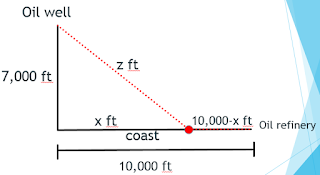
It is pretty hard to be a convincing and effective teacher without believing in the content. But most teachers can probably relate to that feeling of "I have way too much to teach and not enough time to teach it." Not only do I get that feeling, but I also find myself wondering why we try to teach so much content. As a math teacher, I hope that my students will gain the ability to think critically and analyze problems. Everything I teach goes back to that goal. Let me give you and example of content I find extremely beneficial and engaging as well as an example of content that I believe does not help students gain the skills we hope they will gain when learning math. An offshore oil well is situated in the ocean 7,000 feet from the nearest point (point A) on a straight coastline. An oil refinery is located 10,000 feet down the coast from point A. Laying pipe under water costs $16/foot and laying pipe on land costs $7/foot. The engineers want to find the path that will mini...